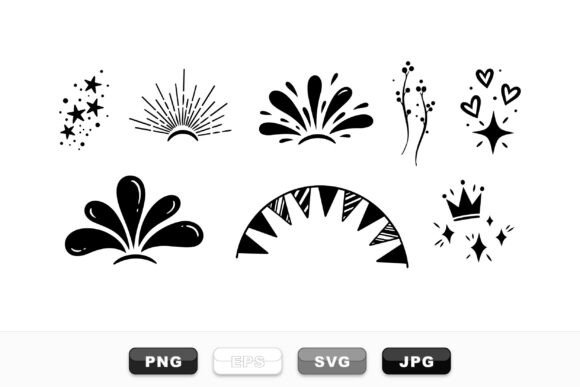
Hand Drawn Decorative Elements: A Practical Guide for Designers
In the evolving landscape of digital design, authenticity often competes with precision. While geometric perfection has its place, there is a growing demand for assets that convey warmth, personality, and human touch. Hand Drawn Decorative Elements represent a specific category of graphic resources designed to bridge this gap. These assets typically include motifs such as splashes, sunbursts, stars, and crowns, rendered in a style that mimics manual illustration. For designers working on branding, packaging, or social media content, understanding the utility and limitations of these minimalist vector sets is essential for making informed creative decisions.
Understanding the Asset Composition
At its core, this type of resource is a curated collection of vector-based illustrations. The term "minimalist hand drawn" implies a deliberate reduction of visual noise. Unlike complex watercolor textures or detailed ink sketches, these elements rely on clean lines and simple shapes to communicate their form. Common motifs found in such packs include dynamic splashes that suggest movement, radial sunbursts that draw attention, playful stars for emphasis, and crown icons that denote quality or hierarchy.
The technical delivery of these assets is crucial for their usability. A standard downloadable package usually arrives in a ZIP archive containing multiple file formats, including SVG, EPS, JPG, and PNG. This variety ensures compatibility across different software ecosystems. SVG and EPS files are vector-based, meaning they can be scaled infinitely without losing resolution, which is vital for large-format printing or high-density displays. Conversely, JPG and PNG files offer rasterized versions that are ready for immediate use in web-based applications where vector support might be limited or unnecessary.
Why Designers Choose Hand-Drawn Aesthetics
The primary driver behind the adoption of Hand Drawn Decorative Elements is the desire to humanize a brand. In an era dominated by sleek, corporate minimalism, imperfect lines and organic shapes stand out. They signal approachability and creativity. For small businesses, artisans, and lifestyle brands, these elements help construct a narrative that feels personal rather than manufactured.
Furthermore, these assets serve as efficient time-savers. Creating custom illustrations from scratch requires significant skill and hours of labor. By utilizing a pre-made set, designers can achieve a bespoke look without the associated production costs. The versatility of motifs like sunbursts and stars allows them to function as versatile accents. They can frame text, highlight key information on packaging, or add visual interest to social media graphics without overpowering the primary message.
Evaluating Benefits and Tradeoffs
When considering whether to integrate these elements into a project, it is important to weigh the advantages against potential limitations. The most significant benefit is scalability. Because the core files are vectors (SVG/EPS), the same star or splash can be used on a business card and a billboard with identical clarity. This flexibility makes the initial investment highly efficient for comprehensive branding projects.
However, there are tradeoffs. The "minimalist" nature of the drawings means they may lack the depth required for certain high-end or luxury contexts where intricate detail is expected. Additionally, because these are stock assets, there is a risk of overuse. If a particular sunburst or crown motif becomes ubiquitous across various platforms, it may lose its distinctiveness. Designers must consider how easily these elements can be customized—such as changing stroke weights or colors—to maintain uniqueness.
Another consideration is the learning curve associated with vector editing. While PNGs are plug-and-play, leveraging the full potential of SVG and EPS files requires proficiency in software like Adobe Illustrator or Affinity Designer. Users who are not comfortable manipulating vector paths may find themselves restricted to the default appearances of the icons.
Ideal Use Cases for Hand-Drawn Vectors
These decorative elements are particularly well-suited for specific industries and applications. Brands in the food and beverage sector, especially those focusing on organic, artisanal, or homemade products, often find that hand-drawn splashes and stars complement their packaging design effectively. The organic feel aligns with consumer perceptions of natural ingredients and careful craftsmanship.
In the realm of digital marketing, these assets excel in social media accents. Platforms like Instagram and Pinterest favor visually engaging, scroll-stopping content. A hand-drawn crown can highlight a customer testimonial, while a splash motif can energize a promotional announcement. The playful nature of the icons helps break up text-heavy posts, making content more digestible and engaging for audiences accustomed to rapid consumption.
Additionally, these elements are valuable for editorial design. Blogs, newsletters, and digital magazines can use sunbursts and stars as section dividers or bullet points. This adds a layer of personality to written content, enhancing readability and keeping the reader’s attention focused on the material.
When to Consider Alternatives
Despite their versatility, Hand Drawn Decorative Elements are not a universal solution. For corporate entities in finance, law, or technology, the playful and informal nature of hand-drawn icons may undermine the perception of authority and stability. In these contexts, geometric, sans-serif, or strictly structured iconography is often more appropriate.
Moreover, if a project requires a highly specific artistic style that does not align with the minimalist aesthetic, custom illustration remains the superior choice. Stock elements, by definition, offer a generalized appeal. If a brand’s identity relies on a unique character design or a very specific texture that cannot be replicated through simple vector lines, investing in a commissioned artist is necessary.
It is also worth noting that for ultra-high-resolution photographic composites, raster-based hand-painted textures might integrate more seamlessly than clean vector lines. Vectors can sometimes appear too sharp or digital when placed over soft, grainy photographs, requiring additional blending modes or effects to harmonize with the background.
Making the Right Decision
Selecting the right decorative elements involves aligning the asset’s characteristics with your project’s goals. Start by defining the tone of your brand. If the objective is to appear friendly, accessible, and creative, minimalist hand-drawn vectors are a strong candidate. Evaluate the technical requirements of your output channels. If you need assets for both print and web, ensure you are comfortable working with SVG and EPS files to maximize quality.
Consider the longevity of the design trends. While hand-drawn aesthetics have remained popular due to their timeless appeal, specific motifs like certain types of sunbursts may cycle in and out of fashion. Choosing a set with a variety of classic shapes ensures that your designs remain relevant longer. Finally, always review the licensing terms of the downloadable ZIP file. Understanding usage rights is critical, especially if the assets will be used in commercial products or client work.
Ultimately, Hand Drawn Decorative Elements offer a balanced solution for designers seeking to add character without sacrificing efficiency. By understanding their strengths in scalability and tone, as well as their limitations in uniqueness and formality, you can determine whether they are the right tool for your next creative endeavor.